2007 · installation, assemblage, puppetry, cabinet of curiosities
Wunderkammer
I built a room inside a room.
I built this as an undergraduate, in an oxblood attic gallery I named into existence by stenciling Cabinet of Artzilantium Gallery on the ladder. I furred the sloped ceiling out with foam board, plastered the walls rough in oxblood, painted the floor dark, and let the pitch of the roof become the pitch of the room. Chris Rand, Joey, and I did the work over several days.
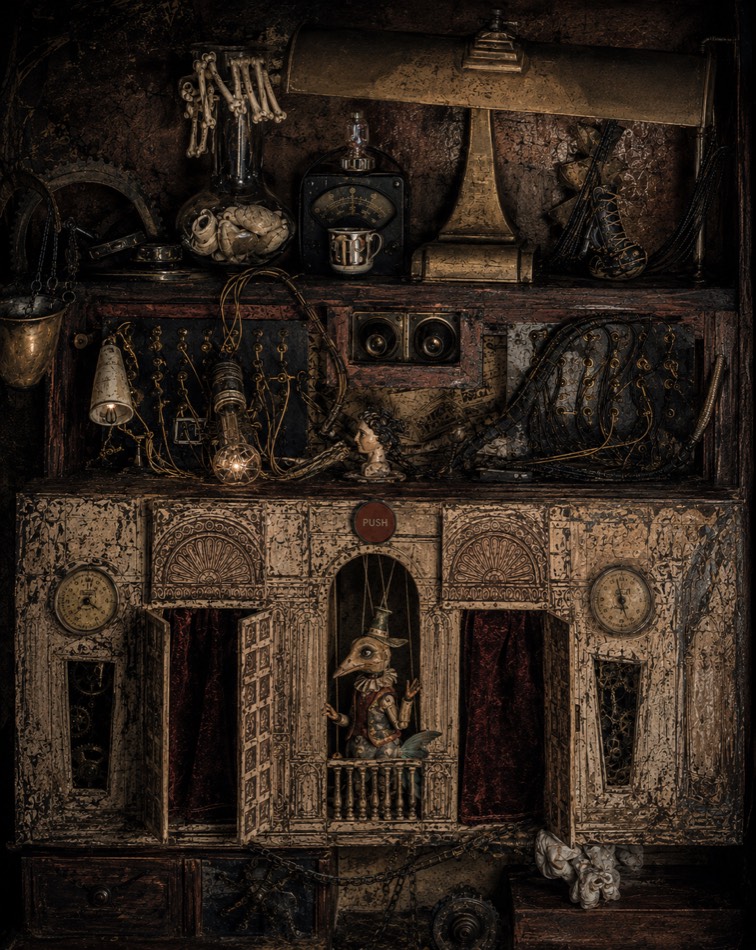
The thing the room exists to contain is a single dense wall of compartments. Salvaged cabinet wood divided into a grid of small dark boxes, each holding something: a brass barometer, a pressure gauge with a pre-war radio beneath it, a bell-jar cage with a tiny figure caught inside, a clock face with no clock behind it, a miniature coffin, a telescope eyepiece pointed at nothing.
One rule governed every object, though I could not have said it aloud at the time: nothing from after about 1940. Brass instruments, pre-war radios, hand-painted clock faces, ground-glass lenses, mercury-bulb thermometers. No plastic, no chrome, no logos from the post-war century, not even ironic ones.
The bird in the small brass cage in front of the pressure gauge is the whole thesis in a single shelf. A measured thing measuring an immeasurable thing.
The wall is two registers stacked, and the difference between them is the piece. The lower register is a painted dollhouse façade: a Romanesque arcade, hand-painted brick, little red-curtained windows, a town shrunk to a child’s scale. The upper register rises straight out of that roofline and is everything the dollhouse refuses to admit. Dark wood, brass, caged figures, gauges, coffins. Instruments of measurement and instruments of restraint, side by side, in compartments too small for a hand to reach.
The orderly thing you live inside is held up from beneath by a town that is held up from beneath by a cabinet you do not have words for.
I did not know I was building that. I built it because the proportions felt right.
To the right of the cabinet, behind a red velvet curtain with a gilt valance, is a marionette stage, its backdrop a pen-and-ink castle town drawn straight onto the boards. A hunched grotesque in a black dress works the stage, with a striped-dress girl and a small boy as the chorus. The donkey puppet in the cabinet above, a cluster of skeleton keys at its throat, is the most alive thing I made.
Set into the cabinet wall is a backlit shadow theater: an insect-headed figure with a fan, standing on a mushroom, a rabbit hovering off to one side, hand-cut from black paper and lit from behind. It is the most graphically resolved image in the room, and the one I would still make today without changing a line.
I built all of it before I had the vocabulary for it. Cornell I knew; the wunderkammer I knew loosely as a Renaissance form. But Švankmajer and Skála I would not meet until Prague in 2017, and when I did, the recognition was immediate. This is what I have been doing.
This is the proto-cabinet of my whole practice. Every cabinet since, the Cabinet of the Wilding Hours, the field naturalist’s wagon, every miniature theater built into a thrift-store box, descends from this room.
Every cabinet I have built since has been an attempt to build this room again, better.
For the longer story of the form this room belongs to — what a cabinet of curiosities is, why the museum could never replace it, and how the instinct runs through everything I have made since — see the essay A Room That Thinks.
The room was the second lane of a larger body. The same spring it hung, the family farm was emptying, and its big iron was becoming machines while its small leavings became these relics. That whole body is gathered at Widdershins as The Ruins of the Midwest.