August 18, 2026
A Room That Thinks
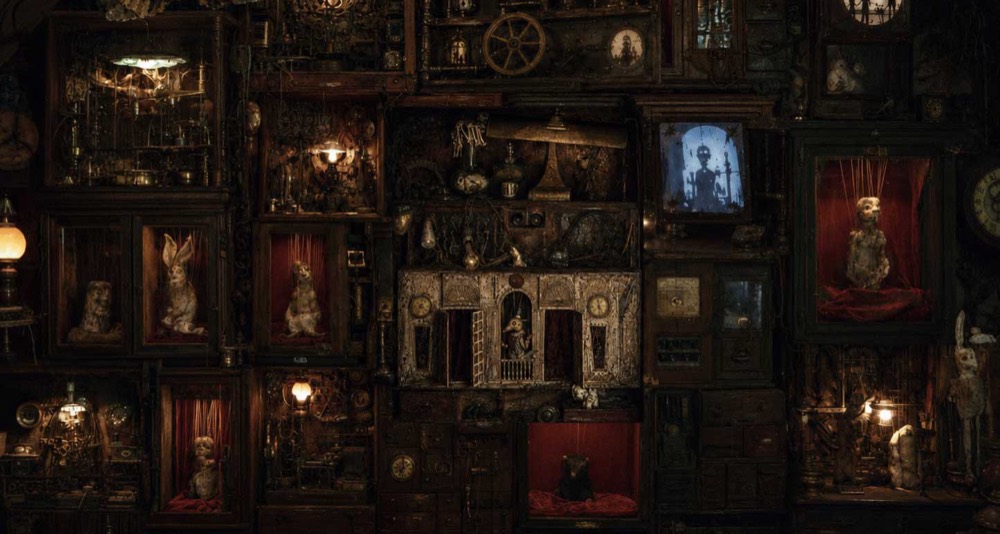
I built a room inside a room once, in an attic, when I was young. Salvaged cabinet wood divided into a grid of small dark boxes, each holding something: a brass barometer, a pre-war radio with visible vacuum tubes, a birdcage with a tiny figure caught inside, a clock face with no clock behind it, a miniature coffin. I plastered the walls oxblood, hung a velvet curtain, and named the gallery into existence by stenciling a half-invented name on the ladder. I called the piece a Wunderkammer because I knew, loosely, that the word meant a cabinet of curiosities, a Renaissance form. I did not know I was joining a lineage that runs back five centuries and forward into a handful of strange museums still operating today. I built it because the proportions felt right.
Years later I went looking for the names. This is some of what I found, and why it turned out to describe nearly everything I have made since.
A room that does its own thinking
A cabinet of curiosities, at its origin, was a single room in which a collector gathered the whole world in miniature. The categories the period used are worth knowing, because they explain the strangeness. Naturalia: the products of nature, a coral, a narwhal tusk sold as a unicorn’s horn, a dried pufferfish. Artificialia: the works of human hands, an automaton, a carved cherry stone, a clockwork saint. Scientifica: the instruments of measurement, astrolabes, compasses, gauges. Exotica: things carried home from far away. The point was not to sort these into separate rooms. The point was to put them in one room, next to each other, and let the visitor’s eye do the work in the gaps.
The historians have good words for what was happening on those shelves. Lorraine Daston and Katharine Park call the register the preternatural, the strange edge of the natural where wonder operates, not the supernatural and not the orderly-everyday either. Krzysztof Pomian calls each object a semiophore, a thing withdrawn from ordinary use so it can carry meaning instead. Paula Findlen describes the cabinet as a social architecture of knowing, the room where a scholar demonstrated what he understood by how he arranged it. In 1565 a Flemish physician named Samuel Quiccheberg wrote the first treatise on how to build one, which means the cabinet was not only a hoard but a teachable practice, a syllabus you could walk through. Five classes of holding, arranged so the arrangement itself was the argument.
That is the part I want to hold onto. The cabinet was a machine for thinking by adjacency. A coral beside a clock beside a Roman coin, and the mind lights up in the space between them.
Why the museum cannot do this
We tell ourselves a comforting story, that the cabinet of curiosities grew up into the modern museum, the way a child grows into an adult. It is a nice story and it is wrong. Eilean Hooper-Greenhill, working from Foucault, makes the case: the museum did not evolve out of the cabinet, it replaced it. The two are different machines that only look alike from outside.
Foucault’s idea is that the deep rules for what counts as knowledge shift between historical periods. The Renaissance organized the world by resemblance: the walnut resembles the brain and so it treats the brain, the gold of the sun answers the gold in the heart of a king. The cabinet is the display form of that mind, objects arranged so their resemblances and surprising neighbors think for you. Then, roughly through the seventeenth and eighteenth centuries, that gives way to taxonomy. Linnaeus arrives with his binomial system in 1735, and suddenly the rule is: same kind near same kind. All the beetles in one drawer, by genus. All the molluscs together, by family. The clock is not in this room at all, it belongs to the science museum across town.
Linnaeus did more practical damage to the cabinet than any critic ever did. The taxonomic machine is genuinely powerful, it is what let comparative biology take off, it is not wrong. But it buys analytic depth at the exact price of cross-category juxtaposition. Here is the cleanest way I know to say what was traded away: the museum cannot put the coral next to the clock and expect the room to do its own thinking. Its whole organizing logic forbids it.
By 1900 the museum had won in every European capital, and specific things were lost in the victory. The cross-category jump, the coral and the clock. The single slow standing mind, replaced by crowd-flow and processional galleries. What Lawrence Weschler, writing about one of the museums I will get to in a moment, calls the wonder-and-doubt complex, the permission to not quite know whether to believe, which the museum’s certain, didactic voice suppresses. And the room as a voice, the collector’s idiosyncrasy as the binding agent, replaced by the committee, the accession policy, the anonymous institutional we. These were real trades, not free gains. The museum bought care and scholarship and public access, which are genuine goods. It could not buy back wonder, juxtaposition, and a single human voice, which are the cabinet’s specific virtues, and they remain unmatched inside the museum’s architecture.
The keepers of the form
The cabinet did not entirely die. It survived as private eccentricity, as fairground amusement, and then, in the twentieth century, it came back on purpose, in the hands of people operating consciously against the museum’s grain.
Joseph Cornell built the shadow box, the cabinet shrunk to the size of a portable universe, a room you hold in two hands. Mark Dion turned the whole apparatus into contemporary art, staging the vanished naturalist’s office, the field archaeologist’s sorting table, letting viewers find the story in the objects with no wall text to tell them what to think. And a few actual museums kept the old episteme alive as a deliberate act. The Museum of Jurassic Technology in Culver City, David Wilson’s deadpan institution, presents its stink ants and its micro-miniatures and its horns of mythical creatures with a straight face, so you leave unsure which exhibits were true, which is precisely the wonder-and-doubt the ordinary museum sands away. The Viktor Wynd Museum in London does it in a retail-and-cocktails register. The Wellcome Collection does it with institutional money behind it. None of these is nostalgia and none is pastiche. It is what the scholars call epistemic supplementation, the argument, made by building rather than by talking, that the museum’s gain in depth was paid for with a loss of juxtapositional power we now have good reason to want back.
Wonder, in other words, is not a childish thing to be quarantined in the school-visit gallery. It is a serious adult discipline, and the cabinet is the room built to practice it.
The cabinet instinct
Which brings me back to the attic. I now understand that the Wunderkammer was not a one-time student piece. It was the proto-cabinet of my whole practice, and once I had the names, I could see the instinct running through everything.
The Cabinet of the Wilding Hours is a cabinet outright, a naturalist’s wagon built to the length of a body, holding watercolor studies and field notes for creatures that a person paid sustained attention to as if they were real. Yonder itself, the studio and gallery, is structurally a cabinet and not a museum: a single voice, a room that is an argument, the candle beside the print beside the watercolor beside the immersive performance, meaning arriving in the gaps. Even the digital knowledge system I keep, the reliquary where this essay was written, is cabinet-grammar applied to plain text files, folders that cross categories on purpose so the synthesis can live between them. Krampusnacht is a cabinet’s wonder-and-doubt complex staged as an event, which is exactly why a museum could never hold it and a cabinet can.
Put together, the honest description is that my whole body of work is one large distributed cabinet, and the mythology I have been tending for decades is its meta-classification. I did not plan it that way. I built each piece because the proportions felt right, and the apparatus caught up to the practice later.
The through-line I have named for myself is revealing the overlooked, and it turns out that is the cabinet’s oldest act. The objects in that attic grid were overlooked things: a dead radio, a broken barometer, a brass fitting from a vanished telephone, a birdcage with no bird. The piece was the act of looking at them long enough that they showed what they had been carrying all along. That is what a cabinet of curiosities is for. It is a bet that a room can think, that small handmade things are more powerful than large bought ones, and that wonder is not a decoration on serious life but a way of taking the world seriously.
I made that bet in an attic, with pink foam board and oxblood plaster and someone’s grandfather’s brass barometer, before I could have told you why. Every cabinet I have built since has been an attempt to build that room again, better.
This essay draws on a longer research base on the cabinet of curiosities kept in the studio’s archive. The piece it keeps returning to is the Wunderkammer, which was the second lane of the 2006–07 farm-severance body now gathered at Widdershins as The Ruins of the Midwest.