2026 · mural
Mill Madonnas
By Don Krumpos & Erin LaBonte
Greene's Pour House at The Granary, 44 W 6th Ave, Oshkosh, WI
The lumber boom built this district. The women who held it together never got a monument. This wall is theirs.
Oshkosh told its own story in the language of the men who owned the mills: Paine, Sawyer, Buckstaff, McMillen. Forty-seven sawmills by 1874. A river so full of white pine you couldn’t row a boat through it. But the city that burned five times and rebuilt itself every time was held together by the people that story leaves out, the women of the Sixth Ward and Polonia.
Mill Madonnas stands in Oshkosh.
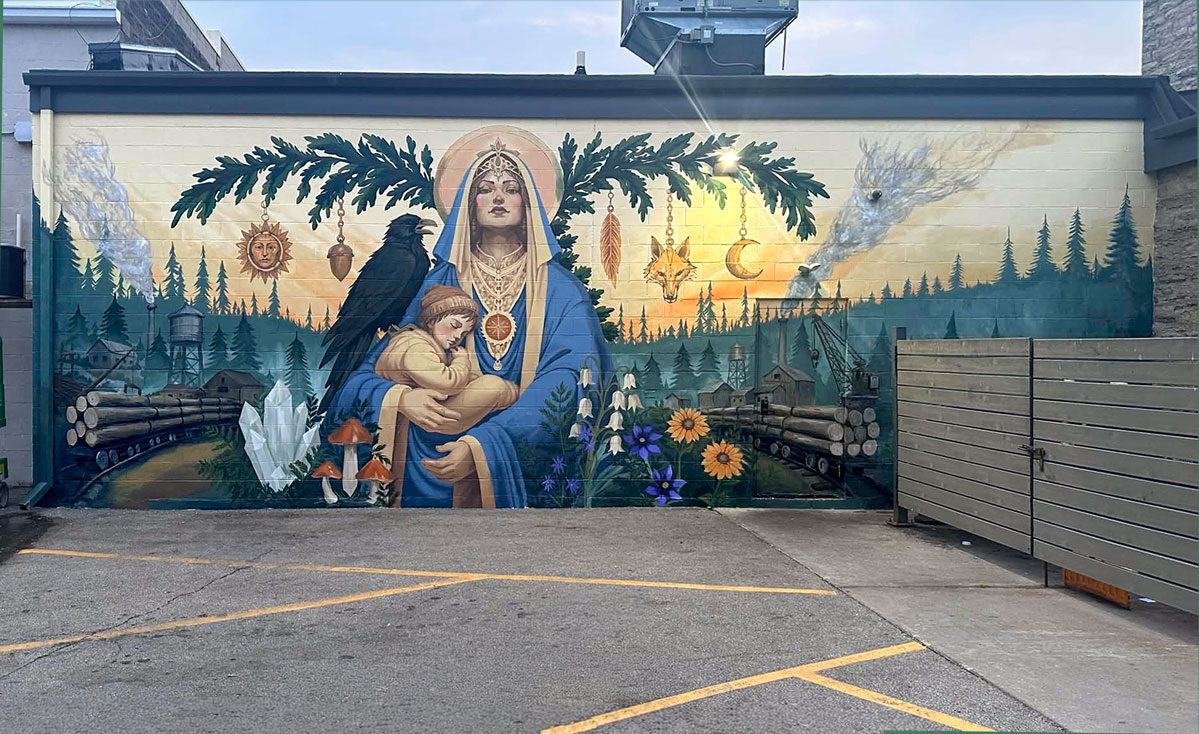
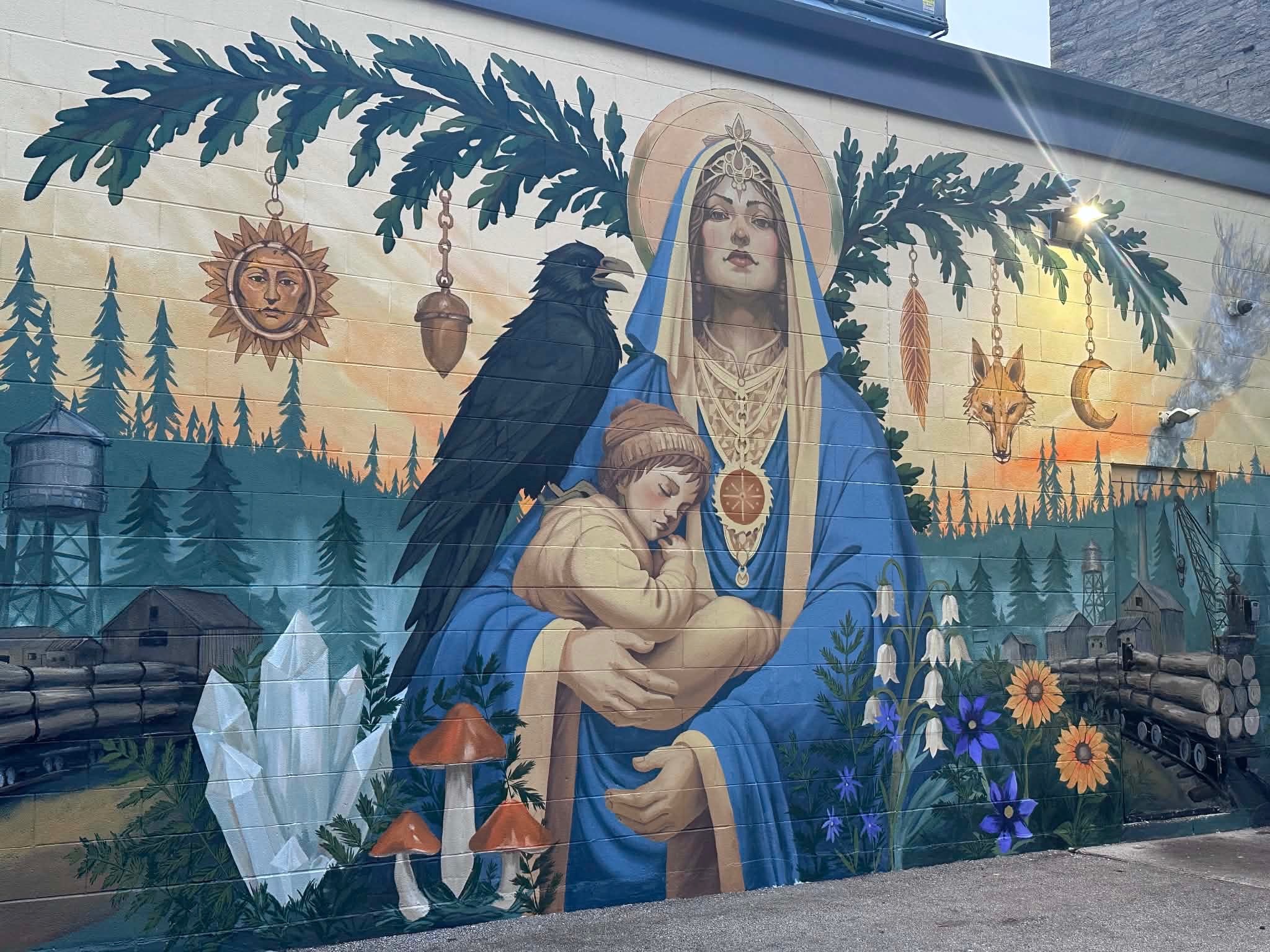
Painted on the back wall of Greene’s Pour House at The Granary, a 40-foot cinderblock canvas in the heart of the Sawdust District, she is a monument to the women the lumber boom forgot. She holds a sleeping child, crowned in pine, a raven at her shoulder, while the mill town works away on either side of her. Log trains, water towers, smokestacks, and the small wild things that came back after the saws went quiet.
The mural is the second work in Discover Oshkosh’s 2026 Riverwalk public art series, commissioned through Spark Towns for a stretch where the Riverwalk pulls away from the Fox River and threads through the Sawdust District before returning to the water. The wall was chosen so that people walking that detour would find something worth the walk. What we put on it is the history the district is named for but rarely tells.
Here is that history in full. We did the research so the wall could carry it, and we are putting all of it here so the record has somewhere public to live.
Sawdust City
Oshkosh sits where the Fox River meets Lake Winnebago, at the bottom of the watershed that drained northern Wisconsin’s white pine. The first sawmill opened in 1847. By 1860 there were eleven mills. By 1873 there were 24 sawmills, 15 shingle mills, and 7 sash-and-door factories, and the nickname Sawdust City had stuck. A year later the count reached 47 sawmills.
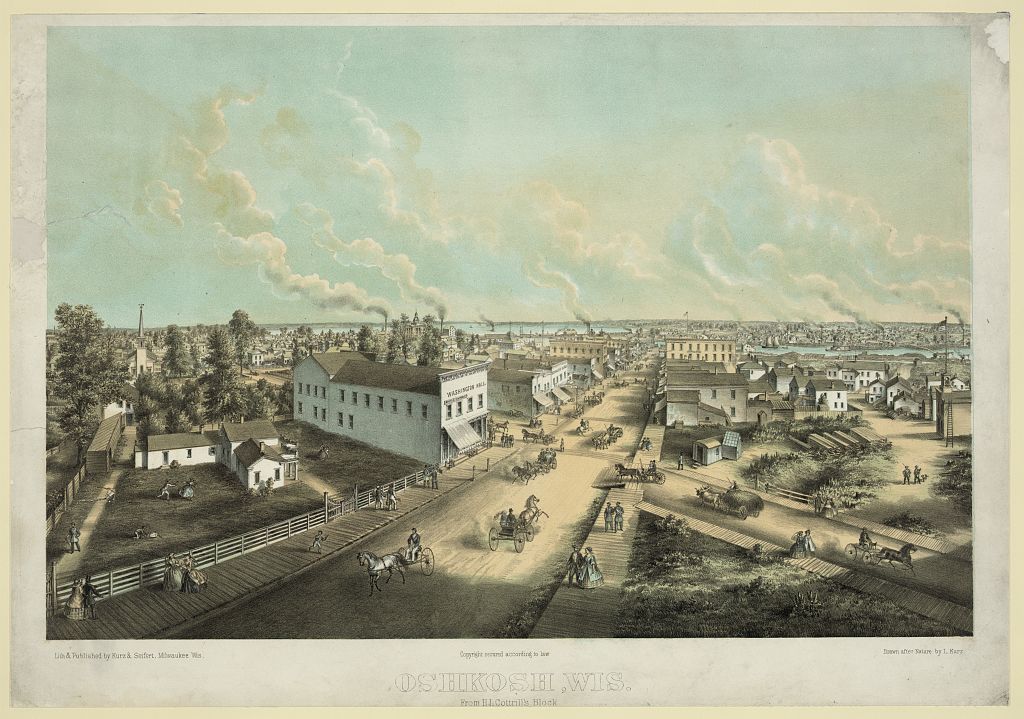
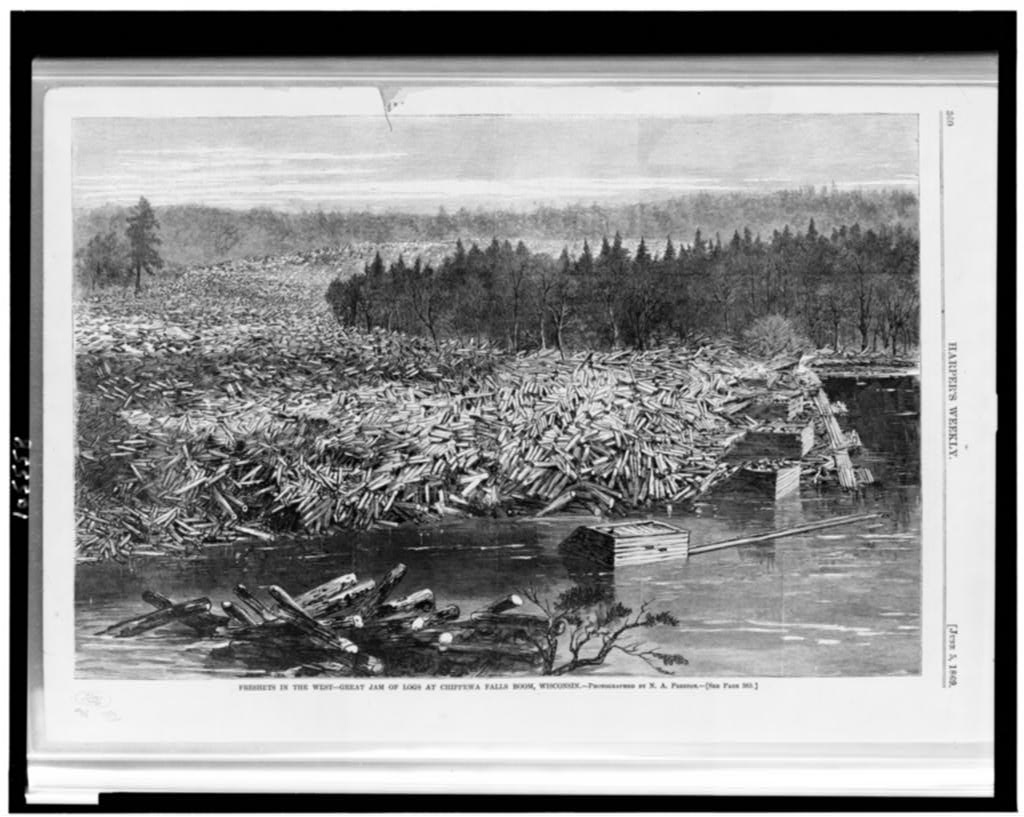
When Chicago burned in 1871, much of the lumber that rebuilt it came down the Wolf River and out of Oshkosh mills. Old-timers said more lumber passed through the Bay Boom at the end of Lake Poygan than any other place in the world, and that the river ran so thick with logs you couldn’t row a boat through it.
The mill owners became the city’s official story: Paine, Sawyer, Buckstaff, McMillen, Morgan, Radford, Gould. Paine Lumber Company grew into the largest sash-and-door manufacturer in the world, sixty acres along the Fox, over two thousand employees. Philetus Sawyer parlayed his mills into a seat in the United States Senate.
A city built of wood by men who milled wood, Oshkosh burned five times. The fire of April 1875 was the worst: seventy stores, forty factories, five hundred homes, the business district destroyed along a swath a mile long. The city rebuilt every time, and the mills ran harder to rebuild it.
The Neighborhood
The blocks around this wall, the south side of the Fox, were settled by the immigrant families who worked the mills. Pomeranian Germans came in the 1850s from rural Prussia. German-Bohemian families, the “Highholders,” came from the border country of the Boehmerwald and filled the Sixth Ward, the ward the newspapers called the Bloody Sixth. Polish Catholic families arrived from 1858 and built Polonia around Sacred Heart parish, on land a woman named Hannah McGreer sold to the parish for fifty dollars in 1872. The Felician Sisters came from Poland in 1874 to teach the neighborhood’s children. After the strike, Volga Germans were brought in from Russia as strikebreakers and induced to stay.
In these households the lumber economy ran on women’s labor that never made the ledgers. Women worked in the door and sash factories at lower pay than the men. Women kept the boarding houses, cooked the meals, did the laundry, kept cows and pigs on hay gathered from south of town, raised the children, and buried the dead. The official story of Sawdust City has almost none of their names in it.
The Strike of 1898
In May 1898 roughly 1,300 workers walked out of seven Oshkosh mills. Most of the workforce was earning $1.10 a day or less for twelve-hour days. Boys were paid forty cents a day for adult work. Women were paid less than the men. The union demanded recognition, a raise, a minimum wage, and, in the contradiction at the heart of this story, the removal of women from mill labor. The men struck for a dignity that excluded the women. The women fought for them anyway.
The strike ran fourteen weeks. The state sent 407 militiamen and set up Gatling guns at the mills. And the fiercest fighters at the gates were the women of the Sixth Ward, who lived within blocks of where this mural now stands.
The Women
Their army was organized around the kitchen table of Lizzie Hando, a 64-year-old widow from Posen who had borne nine children and buried four, who had learned to read English but never to speak it. She led the march on the McMillen mill, in a reporter’s words, “deliberate and cool as if going to a picnic.” A deputy clubbed her over the head. The women behind her put the strikebreakers and the sheriff’s force to flight. The state tried her twice for riot. The first jury deadlocked after 24 hours and 37 ballots. The second deadlocked too, and the case was dismissed. Two juries of Oshkosh men refused to convict her.
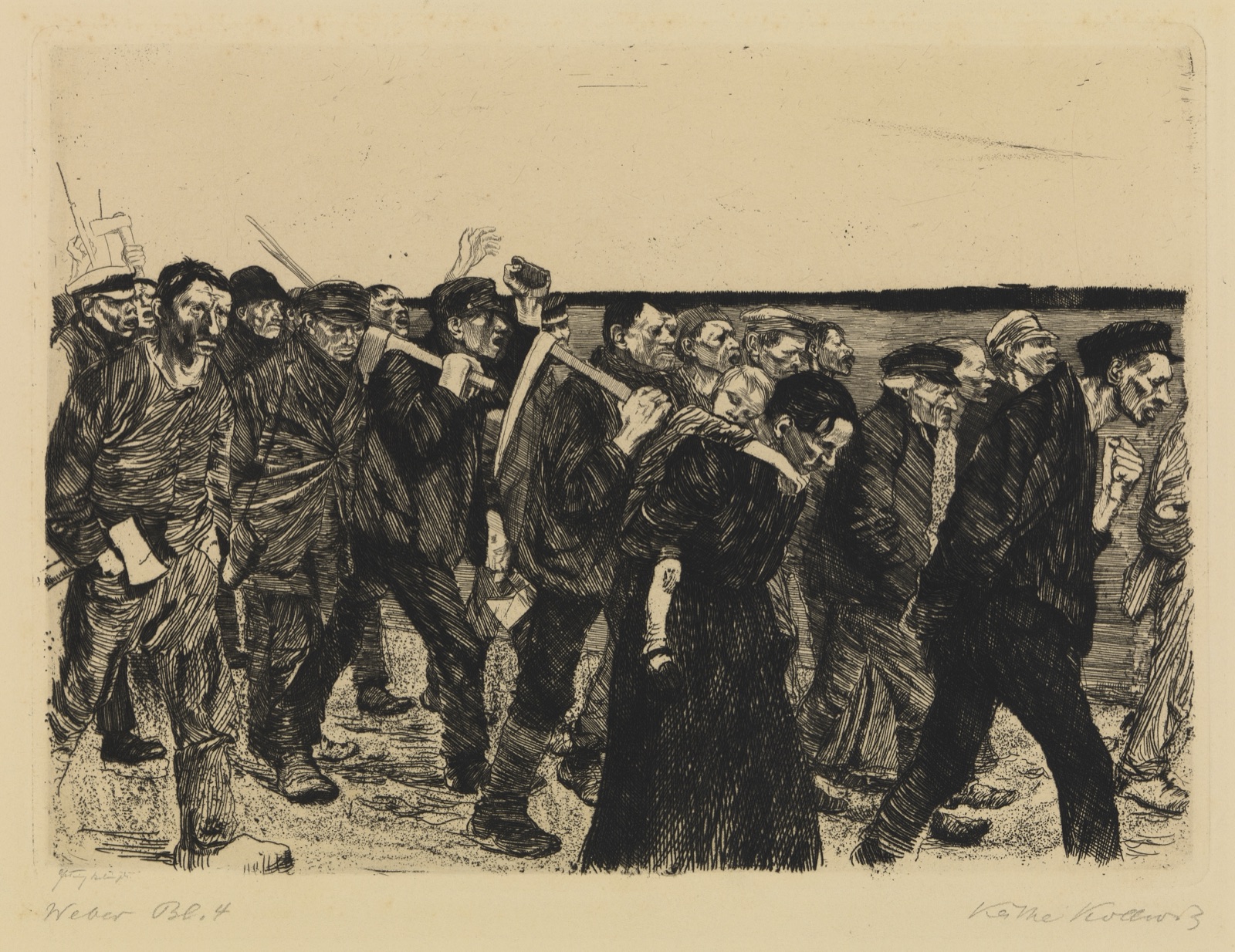
When the newspapers smeared the strike women as “viragoes” and “the very pictures of anarchy,” it was Emma Kunzendorff, the literate one, who wrote the letter that refuted them in print, naming what she had witnessed. When a judge ruled against the women in court, it was Caroline Pomerening who stood and shouted “They lied! They lied!” and kept going in German. Tried on a change of venue, she was acquitted. Beside Lizzie through all of it was her daughter Etta, eighteen years old, the young woman even hostile reporters conceded was intelligent and composed.
Jimmie Morris
And there was Jimmie Morris, a teenaged striker, son of a woodworker disabled in a mill accident. At the riot on June 23, 1898, he turned to the crowd and shouted, “Look at them. The women are fighting harder than the men.” At that moment a mill engineer struck him on the head with a club, and he died that evening. His body lay in state in a pine casket under a placard that read “Here lies the young martyr who died for the union.” Thirteen hundred union men marched behind two bands playing dirges, from the south side meeting hall to St. Peter’s Catholic Church and on to Riverside Cemetery. The man who killed him was tried and acquitted.
What They Won
The strike failed. Three of seven mills gave modest raises. No mill recognized the union. The leaders were blacklisted, and many of the women lost their mill jobs. George Paine went to his grave with no union at his mill, and there was none there until 1956. Clarence Darrow, who came to Oshkosh to defend the union men and won their acquittal, called the strike “one episode in the great battle for human liberty.” Of the women, historian Virginia Glenn Crane wrote that they “gained nothing from their moment of heroic struggle, and all died in obscurity.” Lizzie Hando died in 1917. She and Jimmie Morris both lie in unmarked graves.
For a few weeks in the summer of 1898, immigrant women who owned nothing and could not vote led an army through the streets of a company town. Then the story closed over them. For more than a century, the neighborhood they defended held no image of them.
The Mural
So we painted one. The Mill Madonna is not a portrait of any single woman, but she carries all of them: the widow who led, the scribe who wrote, the orator who would not sit down, the young mother keeping a boarding house, the boy they carried to Riverside Cemetery. The child asleep in her arms is every child raised on mill wages. The raven at her shoulder is the scribe of the wall, keeping the record the papers refused to keep. Her crown of white pine is the forest that built the city, hung with small tokens of the world the sawdust buried: sun and moon, acorn and feather and fox. On either side of her the mill town works on, log trains and water towers and smoke, while wildflowers and mushrooms come back through the cutover at her feet.
She is painted in the register of an icon, working women rendered with the weight of saints, because that is the monument they were owed and never given. She faces the neighborhood the strike women actually walked. Crane’s research maps their homes to these blocks.
The Making
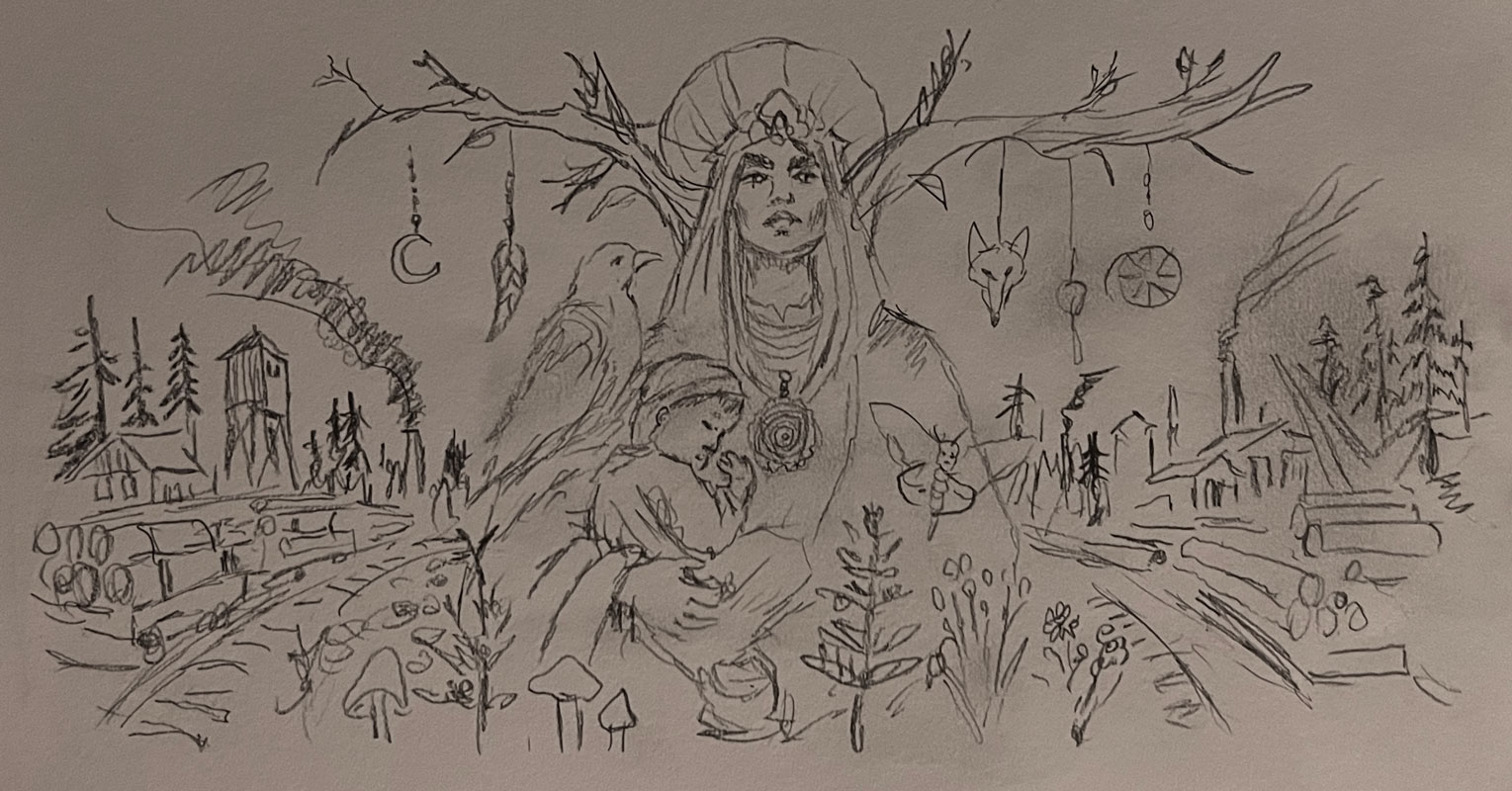
The design began as a pencil sketch, and the bones never changed: the Madonna and child, the raven, the pine crown hung with tokens, the mill town working at the edges.
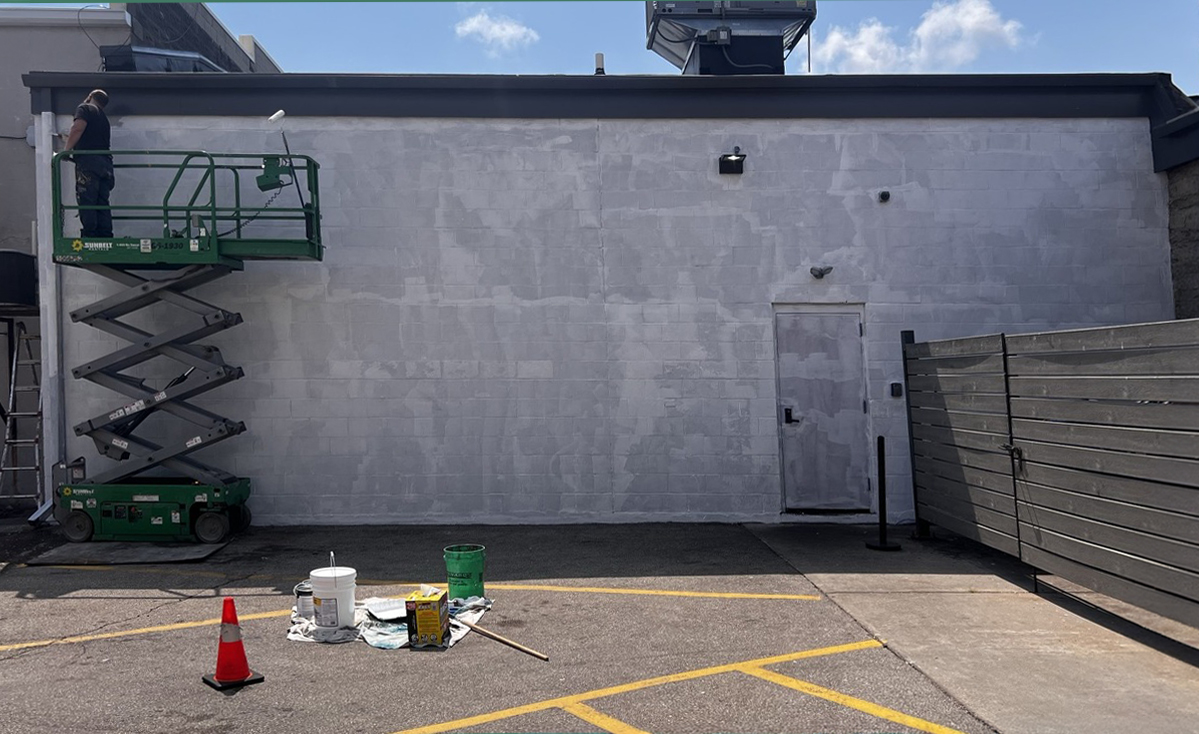
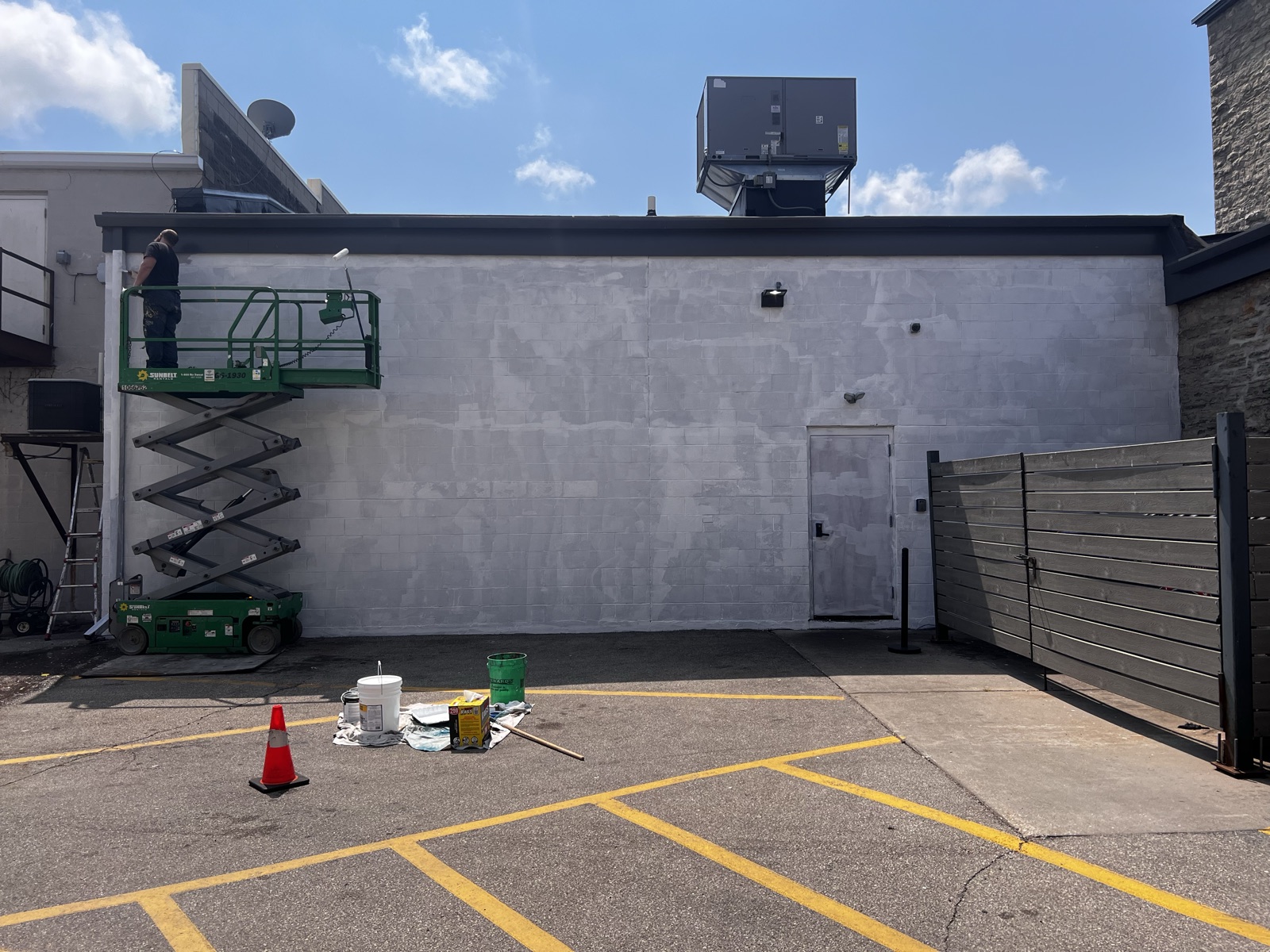
Then the wall itself: nearly six hundred square feet of cinderblock in the rear parking lot, primed white and waiting.
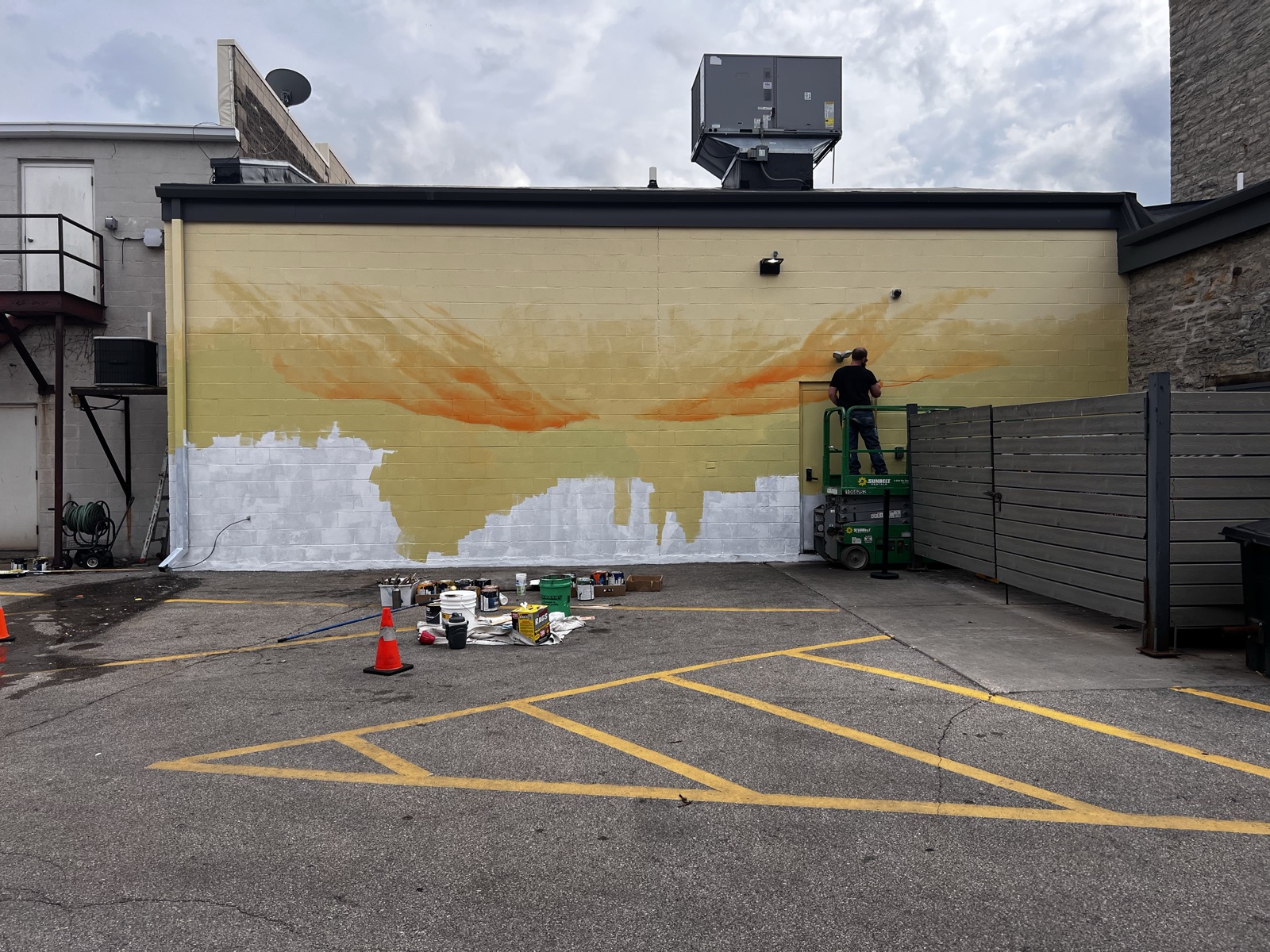
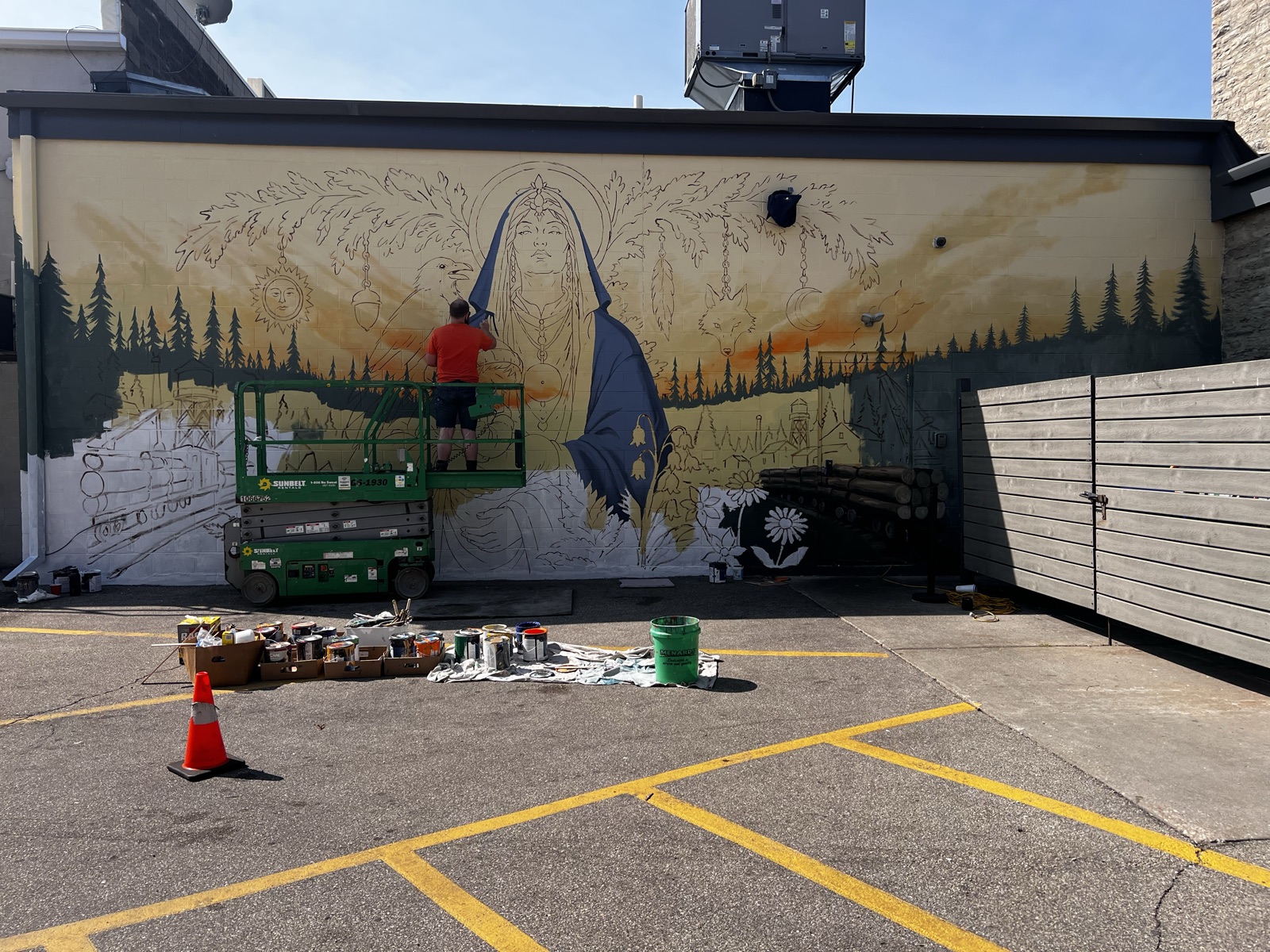
The sky went on first, an orange sunset sweep laid across the block to burn behind the whole composition.
Then, after dark, the whole line drawing was projected up onto the wall and traced by hand, the design transferred to cinderblock at full scale.
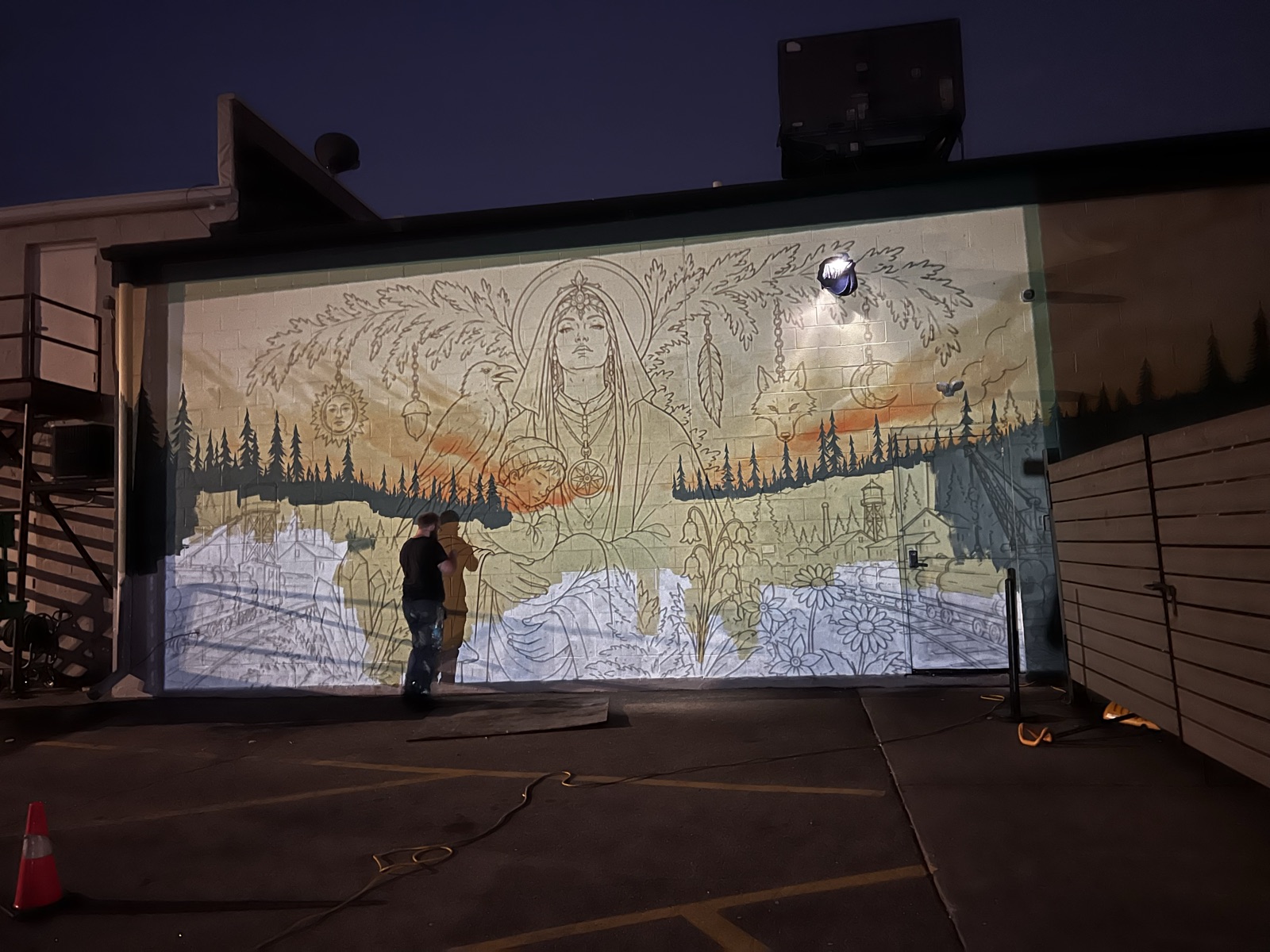
By morning the drawing lived on the wall in line, ready to take paint. Then the long work: the Madonna’s blue robe, the forest, the log trains and the mill town filling in around her.
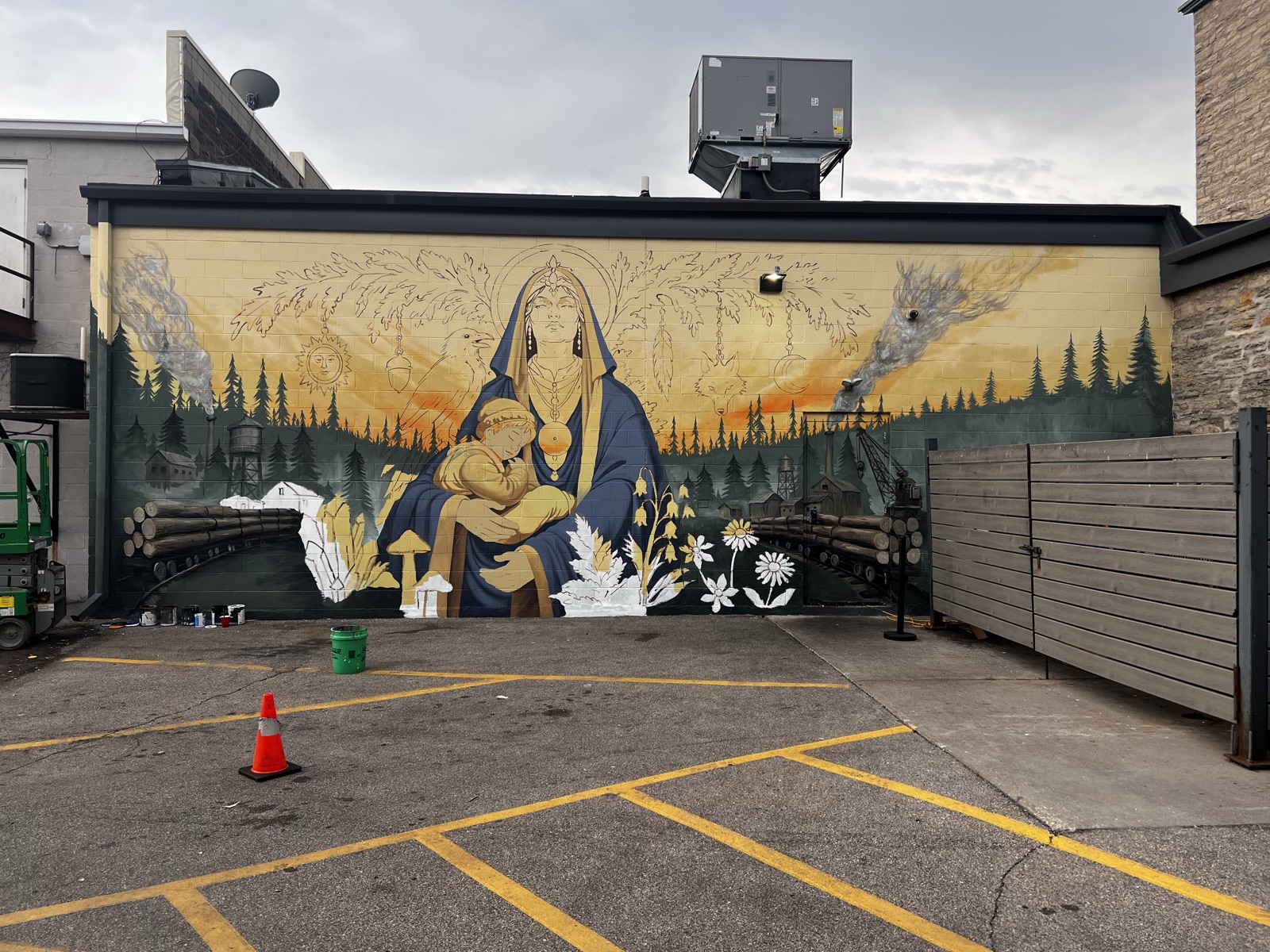
And then she was finished.
Sources and Further Reading
Most of this history comes from the foundational scholarship of Virginia Glenn Crane, professor emerita of history at UW Oshkosh. Start with her article “The Very Pictures of Anarchy”: Women in the Oshkosh Woodworkers’ Strike of 1898 from the Wisconsin Magazine of History, Spring 2001. It is worth reading in full, and her 1998 book The Oshkosh Woodworkers’ Strike of 1898: A Wisconsin Community in Crisis goes deeper still.
- PBS Wisconsin: Oshkosh, Sawdust City — the documentary history of the lumber era
- The Clarence Darrow Digital Collection — the 1898 conspiracy trial of the union leaders
- Oshkosh Woodworkers’ Strike, a summary — Michael Hannon’s overview for the University of Minnesota Law Library
- Sacred Heart Polonia parish history — the Polish south side, Hannah McGreer, and the Felician Sisters
- Oshkosh Public Museum collections — 60,000 photographs of the city, including the mills and the fires
- City of Oshkosh: the Sawdust District — the district today
The archival images on this page are public domain: the Kurz & Seifert lithograph and the Harper’s Weekly engraving via the Library of Congress, and the Kollwitz etching via the Statens Museum for Kunst, Copenhagen.
The mural was announced by Discover Oshkosh on August 10, 2026, as part of the 2026 Riverwalk public art series. “We see these placemaking projects as an accessible way for residents and visitors to engage with Oshkosh’s story,” said Amy Albright, director of Discover Oshkosh, in the announcement. “We hope, in stumbling across these beautiful murals, we will spike people’s curiosity and invite them to learn more about our city and its history.”
Designed and painted with Erin LaBonte, with David Carpenter painting alongside us. Thank you to Spark Towns and Discover Oshkosh, who brought us to this wall, and to Greene’s Pour House at The Granary for giving the Madonna a home.
She faces the riverwalk in the Sawdust District. Worth the detour.
Like this wall? Yonder paints murals across Wisconsin and beyond — homes, businesses, whole downtowns. Tell us about yours.
Start a projectNot ready yet? Follow the work — we'll send word when a new wall goes up.