2007 · Walldog Wave 2007
The Ahnapee & Western Railway Mural
- Painted
- June 21-23, 2007
- Artist
- Bill & Jane Diaz, Pontiac, Illinois (Walldogs)
- Series
- Walldog Wave 2007
- Building
- Algoma Sew & Vac
- Location
- 3rd & Steele, Algoma, Wisconsin (east side of 3rd; mailing address on Steele)
- Condition
- Extant
On the wall of Algoma Sew & Vac at 3rd and Steele, a steam locomotive crosses a trestle beneath two painted slogans. It looks like a survivor from 1900. It isn’t. It was painted in June 2007, and the story of how it got there, and what every detail on it means, is a compact history of this town.
The railroad on the wall
Before Algoma was Algoma, it was Ahnapee. The town took its current name in 1897, but the railroad that reached it five years earlier kept the old one: the Ahnapee & Western Railway, incorporated August 18, 1890 by local landowner and banker Edward Decker to break the Door Peninsula’s isolation, a country of swamps and bad roads where freight moved at a walking pace or not at all. Its rails reached Ahnapee on Lake Michigan in 1892 and stretched north to Sturgeon Bay in 1894. All of 34.5 miles, it joined the wider world at Casco Junction, where it met the line running east from Green Bay toward the Kewaunee car ferries.
On August 1, 1906 the little line was sold to the Green Bay & Western Railroad and spent the rest of its life as a branch, hauling cherries, lumber, and plywood. That last cargo mattered most: during the Second World War the A&W was the lifeline that moved the output of Algoma’s veneer and plywood works, and fed the shipyards at Sturgeon Bay. Passenger service ended in 1937, killed by the Depression and the automobile. The line was abandoned north of Algoma in 1968, and a 1986 bridge washout on the Kewaunee River finished it. Its right-of-way survives as the Ahnapee State Trail, which is why you can today walk and bike the exact route the engine on this wall once worked.
Reading the slogans
The mural carries two slogans, and they come from two different railroads.
“The Rail-Truck Route,” on the A&W herald, was the little line’s own later-era pitch: coordinated rail-plus-truck freight, a short line’s argument for staying useful as trucking ate the short-haul business.
“Shortest Line between Winona, Minneapolis = St. Paul and the Atlantic Seaboard” is not an A&W boast at all. It belongs to the parent Green Bay & Western, “The Green Bay Route,” a classic bridge line that ran east to west from the Mississippi River at Winona, the gateway to the Twin Cities, across the whole of Wisconsin to Kewaunee. There, car ferries carried entire freight cars across Lake Michigan to interchange with the Ann Arbor and Pere Marquette railroads, and through them the eastern trunk lines to the coast. That is how a Wisconsin short line could honestly claim the Atlantic: it was one span of a genuine land-and-water bridge across the continent’s middle. The mural pins the parent system’s coast-to-coast slogan on the hometown branch that fed it.
One small detail worth defending: the ”=” marks flanking “St. Paul” are not typos. They are a period display-lettering convention, double-hyphen dividers, and they belong there.
The locomotive is real
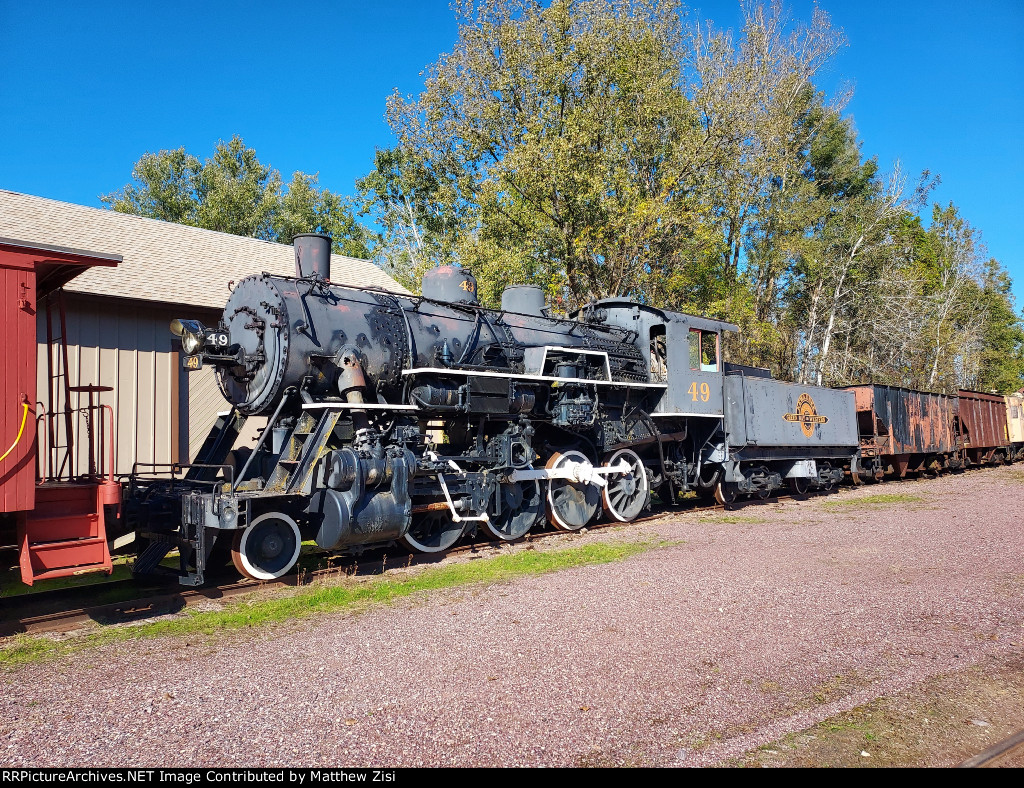
The engine in the vignette is lettered #251, and that number checks out. It is a Green Bay & Western Class B 2-6-0 “Mogul,” built at the American Locomotive Company’s Schenectady works in New York, the exact type the GB&W put onto the A&W in 1915 to replace the line’s original power. Whoever painted this wall lettered a real engine number from the roster that actually worked this line. Look for the Mogul’s signature: one small pony wheel, three large drivers, no trailing truck, two domes on the boiler top with the bell between them and the stack.
The Moguls sit in the middle of the line’s whole story of power, which is worth telling in full. The A&W began the 1890s with three little 4-4-0 “Americans,” numbered 1 through 3, the classic wood-pilot engines of every western movie. The 1915 Moguls that replaced them were the workhorses of the middle years, and #251 was one of them. Heavier freight brought heavier engines, 2-8-0 “Consolidations” like #74, #261, #351, and #398. And in 1952 and 1953 two 70-ton General Electric diesels, #600 and #601, ended steam on the branch altogether. Photographs of #251’s sister engines survive in railroad collections, #256 photographed broadside in Green Bay in May 1948, #255 at the same three-quarter angle the mural uses; a period photograph of #251 herself is still being hunted, and if you have one, we want to see it.
The large brick building behind the engine is most likely Algoma’s veneer and plywood works by the river, the railroad’s biggest customer, though the source photograph behind the vignette has not yet been located. Finding it is an open project of this register.
The Walldog Wave
Over three days, June 21 to 23, 2007, more than one hundred Walldogs, an international guild of mural and sign painters who keep the old hand-lettering craft alive, descended on Algoma and painted ten murals on ten historic downtown buildings. The event was conceived through the Algoma Main Street Program’s preservation work, and it came here because a Walldog lived here: Dave Petri coordinated the meet from inside the community. The murals honor Algoma businesses and history from before 1960. This register documents every wall in the set.
This wall was led by Bill and Jane Diaz of Pontiac, Illinois, and sponsored by Algoma Hardwoods, Inc., which is a fitting patron: the plywood works was the railroad’s biggest customer, and the brick building in the vignette is most likely its ancestor. Some listings credit this mural to Chris Shuster, but that appears to be a mix-up between Algoma’s two Ahnapee murals: the railway wall, and the Ahnapee Brewery mural that stood on the Pizza Bowl at Second and State until it was saved from demolition and moved to the brewery’s taproom in Suamico. The Main Street Program’s own walking-tour brochure credits the railway wall to the Diazes.
If you painted here in 2007, or have photographs from that week, we would genuinely like to hear from you.
Stewardship
Yonder Art Land is restoring this mural in August 2026, ahead of the Walldog Wave’s twentieth anniversary in 2027. The restoration is being done with the history above in hand, so the lettering conventions, the slogans, and engine #251 stay true to what the Walldogs put up.
Sources
- Historic Algoma Walking Tour, Volume II (Algoma Main Street Program brochure; ed. Leon Raether)
- Door County Pulse: A Community’s Vision, the Murals of Algoma (2018)
- Greater Green Bay Mural Guide
- American-Rails: Ahnapee & Western Railway
- American-Rails: Green Bay & Western Railroad
- Abandoned Rails: Ahnapee & Western
- Wikipedia: Ahnapee and Western Railway
- Door County Pulse: The Rise and Fall of the Ahnapee & Western Railway
- Travel Wisconsin: Algoma Historic Murals
- Visit Algoma: Art History Quest (Walldog Wave)