2007 · photography, spirit of place, landscape, wisconsin
Amphitheatre of Hills
The ground gives back none of what happened on it. That absence is the picture.
In 2007 I drove to Mineral Point and photographed an empty field.
In 1842, in the low ground below that town, a man named William Caffee was hanged for murder. The gallows stood in a natural bowl, a flat valley bottom ringed by hills, and five or six thousand people came out on a mild November day to watch. They spread up the slopes as if the hills were seating. The accounts of the day called it an amphitheatre, and said the crowd was every age, sex, color and condition, down to infants at the breast. It was a picnic. It was the whole county come to see a man drop.
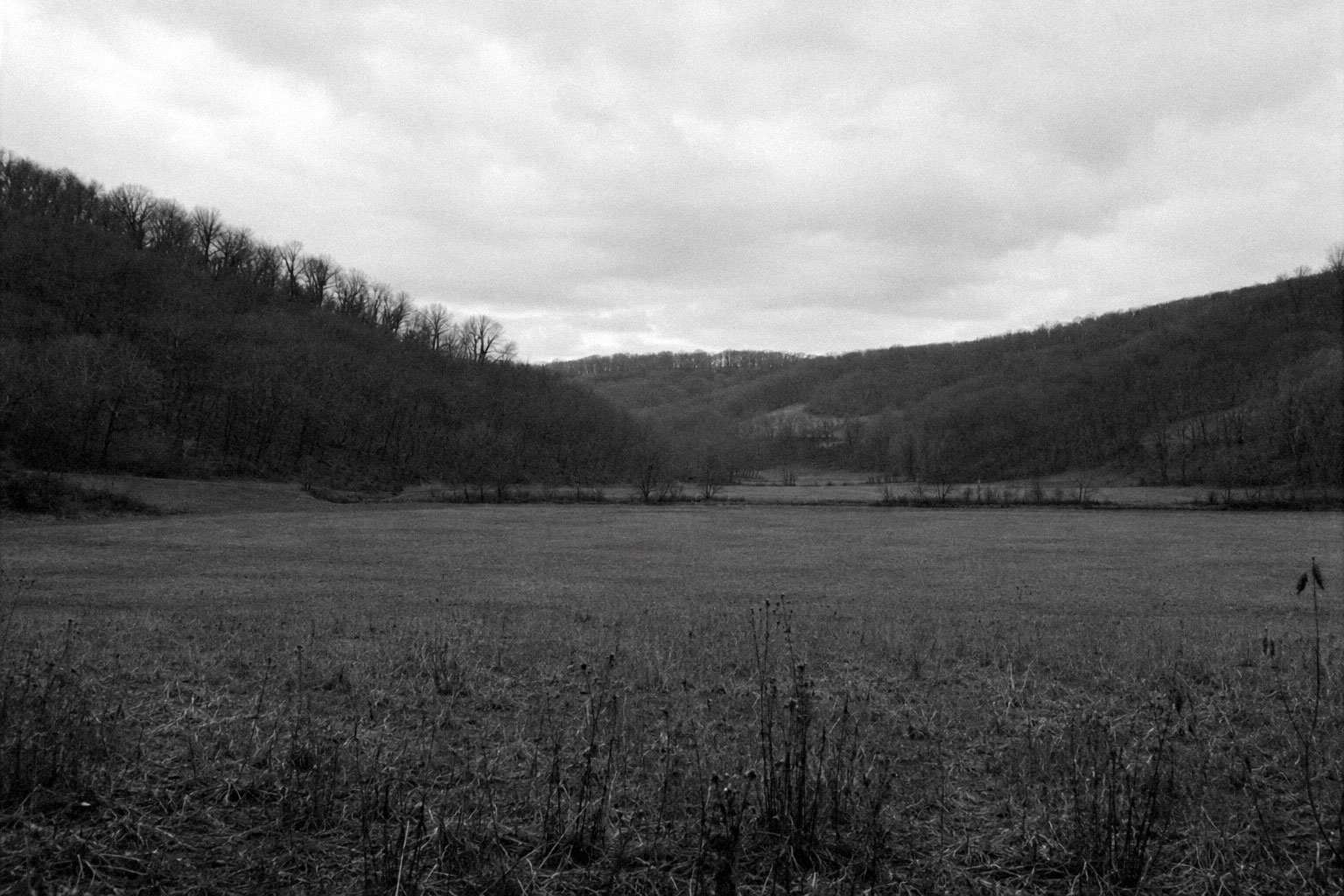
I stood in the bottom of that bowl a hundred and sixty-five years later and made the first photograph. There is nothing in it. Dead grass, bare trees, the hills still tiered around the flat exactly as they were, a low gray lid of sky. The ground gives back none of what happened on it. That absence is the picture. I wanted the viewer to stand where the scaffold stood and feel the field refuse to confess.
The second photograph is the same event with the ground taken away. I built a noose and lit it so that only its shadow fell on the paper, because the rope itself has been gone for a century and a half and what survives is the shape of it. Two figures watch from below, faces turned up toward the shadow. They are the six thousand, reduced to the two faces a single picture can hold. The killing was built to be seen. I gave it back its witnesses.
Together the two images are the two halves of what a place like this becomes: the ground that forgets, and the gaze that once made a killing into an afternoon. Mineral Point kept the ghost and lost the field. It tells Caffee’s story as a rattle in a tavern up on the hill and leaves the killing-ground blank and unmarked in the valley. I went looking for the field.